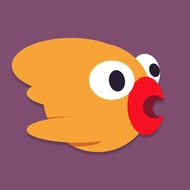
In Lava Bird you start with a single flap and no way to slow yourself down, which matters the instant the first pursuer shows up on screen. There’s no health bar to buffer your mistakes and no pause between waves — just you, the lava, and whatever is chasing you from behind. That single rule is what makes the opening seconds of Lava Bird deceptively calm before everything speeds up.
| Genre |
Arcade shooter / side-scroller |
| Platforms |
Browser, iOS, Android |
| Structure |
Endless run with escalating waves |
| Core mechanic |
Flap to fly, fire automatically in the direction you’re facing |
Flap-and-Shoot Timing in Lava Bird
The core loop sounds simple: tap or press spacebar to flap upward, and every flap also launches a fireball ahead of you. What trips up new players is realizing those fireballs don’t disappear once fired — they arc forward and can hit you on the way down if you’re not tracking their path. Beginners tend to treat the spacebar like a pure jump button, mashing it the way they would in an old flash game, and end up boxed in by their own shots within the first ten seconds.
Once you stop thinking of it as flying and start thinking of it as spacing, the game opens up. You learn to flap in short bursts, let a fireball clear the screen, then flap again rather than spamming. This is the first real skill wall in Lava Bird, and it’s the one that separates a five-second run from a run that actually reaches the harder waves.
There’s also a rhythm to the lava itself rising and falling in the background, which some players use as a visual metronome for when to commit to a flap. It’s not spelled out anywhere in the game — it’s the kind of thing you only notice after enough failed runs.
Enemy Waves and the Ice Level Shift
Early runs only involve the standard chasers, but by the time you reach the ice level the palette changes and so does the pattern of incoming threats. Players in the community usually call this section “the cold stretch,” since the pacing noticeably slows before ramping right back up. The transition catches a lot of people off guard because the visual slowdown reads as a breather, when it’s actually the game resetting difficulty before stacking it higher.
Enemies increase in difficulty over time, and that’s not just marketing language — the spacing between chasers tightens noticeably after your first few waves. High-score chasers tend to memorize the cadence of each wave rather than reacting in real time, since Lava Bird rewards pattern recognition more than raw reflexes once you’re past the early minutes.
The Shield and Survival Tools
A handy shield can be earned during a run, and it’s the closest thing Lava Bird has to a safety net. It absorbs one hit, whether that’s a fireball you fired yourself or one from an enemy, and then it’s gone. New players often forget it exists until they’ve already died to something they could have shrugged off.
Two-player mode changes the equation entirely, splitting the birds into red and blue with separate controls — W for one player, the up arrow for the other. It turns a solo dodging puzzle into a shared-screen scramble where you’re just as likely to clip your friend’s fireball as an enemy’s.
Where Lava Bird Runs Get Predictable
It’s worth being honest about one thing players bring up often: once you’ve learned the fireball patterns, later waves in Lava Bird can feel repetitive rather than harder. Several long-time players note that staying near the top of the screen and tapping quickly left and right dodges most late-game fireballs, which trims some of the tension out of runs once you’ve unlocked that trick. It’s not a dealbreaker, but it’s a real ceiling on how much the difficulty curve can surprise you after enough hours.
How do you avoid getting hit by your own fireballs in Lava Bird?
Keep a beat between flaps instead of holding the spacebar down. Since every flap fires a shot forward, tapping in short intervals gives each fireball room to travel before you flap again, which is the main fix players find after a few early deaths.
Why does Lava Bird suddenly feel harder around the ice level?
The ice level marks a difficulty reset that ramps back up faster than the opening stretch. Enemy spacing tightens noticeably here, so the calmer visuals are misleading — treat it as the start of a new, faster wave rather than a rest point.
What does the shield actually do in Lava Bird?
The shield blocks exactly one hit, including your own fireball rebounding into you, before disappearing. It’s earned through play rather than purchased, so tracking when you last picked one up matters more than most players expect.
Lava Bird rewards the kind of player who treats every flap as a decision rather than a reflex, and that’s still true dozens of runs in. Whether you’re chasing a new high score solo or splitting the screen with a friend in two-player mode, the fireballs you fire yourself remain the real obstacle, right alongside the ice birds closing in from behind.