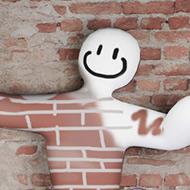
What happens the moment a Seeker walks directly past a Hider who painted themselves perfectly into a wall? Nothing — and that split second of nothing is the entire appeal of Meccha Chameleon, a multiplayer hide-and-seek game where survival depends on how convincingly you can paint your own body into the scenery around you.
| Genre |
Multiplayer party / hide-and-seek |
| Platform |
Windows |
| Players |
2–10 recommended |
| Release |
2026 |
Painting Your Way Into the Scenery
Every Hider begins each round as a plain white figure standing in an empty stage. Before the Seekers are released, you get a short window to paint that white body to match nearby surfaces using a simple brush-and-eyedropper toolset. A player hiding near a wooden fence might paint themselves brown and streaked; someone tucked beside patterned playground equipment might attempt something far more elaborate. The quality of the paint job matters, but so does where you chose to stand — a flawless disguise in the wrong spot gets spotted instantly, while a rough one in a smart position can survive an entire round.
This is the detail that separates Meccha Chameleon from other hide-and-seek formats built around ducking behind static props. Nothing here is pre-made. You are the disguise, which means two rounds on the exact same map can play out in completely different ways depending on who’s hiding and what they decided to paint that time.
Beginners almost always make the same mistake early on: they focus entirely on color accuracy and forget about pose. Standing upright against a horizontal shelf reads as wrong no matter how perfect the paint job is, so learning to cling to walls and match the silhouette of the object you’re mimicking matters just as much as picking the right shade.
Seeker Sweeps and Reading Suspicious Shapes
Seekers have the opposite job. Instead of painting anything, they patrol the stage looking for shapes that don’t quite belong — a slightly wrong texture, an edge that moves when it shouldn’t, a color that’s close but not exact. Once time runs low, some maps make this sweep genuinely tense, since a missed Hider in the last few seconds can flip the round.
Community vocabulary has already formed around this role. Players talk about “cheesing” a hiding spot, meaning picking a location so obscure or so visually noisy that even a mediocre paint job survives a full sweep. A dedicated Seeker main learns to check the same handful of exploitable corners on each map before doing a slower, more careful scan of everything else.
Infection Mode Versus Normal Mode in Meccha Chameleon
The host can choose between two core rule sets. In Normal mode, a tagged Hider is knocked straight out of the round and the Seekers win once every hidden player has been found before time expires. Infection mode changes the math entirely: a tagged Hider instantly switches sides and joins the hunters, so the seeking team snowballs larger and larger as the round goes on, turning a slow start into a chaotic finish.
Infection tends to be the mode competitive players gravitate toward, since a single early tag can shift the entire momentum of the match. Casual groups more often default to Normal mode, where the pressure builds gradually instead of compounding all at once.
Customization, Skins, and Paint Guns
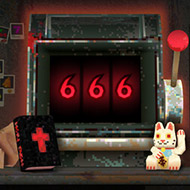
Coins earned by playing and leveling up unlock cosmetic layers that don’t affect the painting mechanic itself but change how a session feels. Skins and patterns range from brick and jungle textures up to neon and galaxy looks across different rarity tiers, and body shape options — round, box, or triangle — combine with poses including a signature wall-cling stance that experienced Hiders lean on constantly.
- Skins and patterns, from common textures to legendary rarities
- Body shape choices — round, box, or triangle
- Paint guns for Seekers, trading fire rate against reach
- Camouflage palettes, stickers, emotes, and taunts
Paint guns matter more than they first appear to. A rapid-fire option covers more ground during a frantic sweep, while a slower, more accurate gun rewards a Seeker who’s already narrowed down a suspicious corner and just needs one confirmed hit.
Mobile Controls and Cross-Platform Play in Meccha Chameleon
On touch devices, hiding uses a swipe-to-look system paired with a tap-to-paint interaction — tapping a surface applies its color, and tapping a wall lets you soak up that surface’s tone directly before rotating to face it and cling. Seeking on mobile swaps to a joystick-and-fire-button layout, with aiming handled through swipe gestures. The underlying mechanics stay identical to the desktop version; only the input method changes.
Once you reach a map with more complex geometry — layered shelving, patterned murals, mixed lighting — the painting mechanic stops being about matching a single flat color and starts requiring actual multi-tone blending, which is where a lot of the game’s most memorable disguises come from.
Common Questions About Meccha Chameleon
- How many players can join one match of Meccha Chameleon? Lobbies are built around 2 to 10 players, though the practical maximum depends on the host’s own network connection rather than a hard-coded server limit.
- What’s the difference between Infection and Normal mode? Normal mode removes a tagged Hider from the round entirely, while Infection converts them into an additional Seeker, so the hunting team keeps growing until only one Hider remains uncaught.
- Can you play Meccha Chameleon on Mac? The core release currently supports Windows only, which is a frequent point of frustration raised by players on the game’s own community boards.
What keeps a lobby coming back isn’t the map list or the paint gun selection — it’s the unpredictability that comes from every Hider making a different call about color, pose, and positioning in Meccha Chameleon. A wall-clinging disguise that fools three straight Seekers on one map can get spotted instantly on the next, and that inconsistency, more than any fixed skill ceiling, is what keeps rounds from ever feeling scripted.