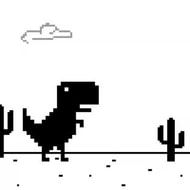
Dinosaur Game places the player in control of a running dinosaur that must avoid obstacles and react to changing patterns while maintaining continuous forward motion. The challenge increases as speed rises, requiring quick decisions, careful jumps, and rhythm awareness. Although the structure appears simple at first, the difficulty scales steadily, and players soon realize that survival depends on learning movement timing and adapting to randomly generated sequences.
Movement Timing, Obstacle Variety, and Speed Scaling
The core structure of Dinosaur Game revolves around jumping over cacti and ducking under flying hazards. Early stages offer slow, predictable patterns, but the longer the run continues, the faster the dinosaur moves. This forces the player to anticipate upcoming objects before they appear. Every obstacle type requires precise timing, and even a minor delay leads to failure. The challenge is therefore less about memorizing level layout and more about mastering reaction skills.
- Jump control: Adjust jump height to avoid mistimed landings that reduce reaction time.
- Ducking practice: Learn the difference between low and high flying obstacles.
- Speed adaptation: Prepare for sharper timing as the dinosaur accelerates.
Environmental Shifts, Visual Cues, and Player Strategy
Dinosaur Game includes visual changes such as day–night cycles that influence visibility. While these changes do not directly affect obstacle placement, they alter the player’s ability to read shapes clearly. Understanding silhouettes during dark cycles becomes an essential skill. Players develop a personal pace through consistent attempts, noticing how the dinosaur’s momentum feels at specific speeds and learning how to navigate each interval.
- Silhouette reading: Rely on shape outlines during low-visibility cycles.
- Spacing awareness: Track the distance between obstacles to prepare for double sequences.
- Reaction planning: Position hands and focus ahead of the dinosaur rather than on the character itself.
Frequently Asked Questions and Performance Improvement
Players often ask how to last longer or how to overcome the sudden difficulty spike that appears once speeds become extreme. One helpful tactic is maintaining a consistent eye position a short distance ahead of the dinosaur, instead of watching the dinosaur directly. Another method involves practicing both short and long jumps to manage cacti with varying heights. Understanding rhythm patterns helps keep movement smooth, making intense sections easier to navigate.
- Attention focus: Look ahead rather than directly at the dinosaur’s feet.
- Jump variety: Use short jumps for small cacti and long jumps for grouped obstacles.
- Calm pacing: Avoid panic during high-speed phases by maintaining steady breathing.
Dinosaur Game provides a continuous, endurance-based challenge that grows more intense as the run progresses. Mastery comes from repeated attempts, pattern observation, and patience. As players refine their timing and reaction skills, they begin to navigate longer sequences with confidence and consistency.